
Folio 194r
(Cinnamon, cont.)
Give a fine grinding of cinnamon in food with a grinding of caraway. It can also be put in sauces appropriately for stimulating the appetite impeded by excess humors, in this way: when a sauce is made with parsley, sage, a little vinegar and the aforesaid ground spices.
It may be chewed for freshening the breath.
And note that although the mouth may seem fragrant for a while after chewing these aromatics, later, however, it becomes corrupt, as though from the use of warm things, like cloves and the like, since they dispel warmth, whence arises putrefaction.
Cinnamon is not so warm that it dispels this, but it is nevertheless binding[1] <of wounds or bones>.
For fresh fissures of the lips or other sores: put ground cinnamon on the fissures and afterwards a suture, and it will be bound together well.
Against infected gums, make a wash of it with salt water, and let them be rubbed and scored well, so that blood flows and the putrid drainage flows out. The mouth can then be washed with wine in which cinnamon is steeped; afterwards a powder made from 2 parts of comfrey and a third of cinnamon works in a marvelous way.
Against fainting and heart trouble: give ground cinnamon with ground cloves.
Thick cinnamon is never put in emetics by itself, for it does not generate much nausea, but it represses the violent action of other spices, like deadly carrot[2] and the like. For it soothes the stomach, whence there is a two-fold use for it.
Cinnamon cures cough and catarrh from thick mucus.
Mixed with a medicine for eye sores, it dries excessive humors of the eyes.
Ground and mixed with vinegar, it eliminates patchy skin and freckles.
It soothes pain of the kidneys.
It cures dropsy, distention of the abdomen by gas,[3] and snakebite.
It opens blockage, dissolves food, dissolves phlegm, stimulates urine and the menses.
Chap. 17 (f. 194r): Concerning Wall Germander (Camedreos)

Teucrium chamaedrys Wikimedia Commons
Wall germander is warm and dry in the fourth degree. Like camepitheos (): camedreos is called greater ground oak[4], camepitheos lesser ground oak. It has a diuretic and cleansing power, but since they are similar in effect, the same handling is prescribed for both.[5] It should be gathered at the end of spring when its flowers come forth. Then the roots, with the plant’s flowers cast aside, can be dried in the shade and it may be kept with great efficacy for a year.
Against strangury and dysuria or intestinal pain and obstruction of the spleen and liver: this plant or the other, alone, when cooked in saltwater, can be plastered on the pudenda and the kidneys. It may also be given steeeped in wine.
Against intestinal disccomfort: a powder of it can be administered in a clyster, with salt water, honey, and olive oil.
Against an obstruction of the spleen and liver and urinary ducts: the plants can be plastered on the spot affected when cooked in wine and oil. Also, an electuary which is prepared from honey and two parts of either ground germander and one part of lynx stone and saxifrage. Against strangury and dysuria and against a stone, and it will not be also necessary to seek litontropon[6] or the duke’s electuary,[7] if this be had, since it is wonderful against all.
Against a hardness of the spleen and liver: let a decoction of the powder of one or the other of these be prepared in oill and placed on the liver or spleen. If we have fresh plants, let them be put in wine for nine days so that they can rot there. Afterwards, let them boil almost to the point of consumption. Afterwards, they can be expressed through a fine-woven and sturdy cloth until all the liquid comes forth. From that liquid and wax, an unguent can be made, proven for the spleen and liver.
Against vomiting caused by the expulsion of food or some other cold cause, let these herbs themsleves or more be cooked for a long time in salt water or in natural salt water[8], aand with the addition of oil and a measure of vinegar, a plaster can be made on the chest. This is the greatest remedy against vomiting, whichever sort comes from a cold cause.
Powdered germander given with honey kills round worms.
Against catarrh: let a warm powder of it be put in a sachet and placed on the head; this is the best remedy.
For scurf[9] of the head or beard: let the flour of bitter lupine be cooked in salt water with vinegar added, and placed in a strainer with ground germander of either sort, and the head be bathed with it after.
Against paralysis: the plant steeped in wine can be placed on the affected area.
Powdered germander knits together ulcers and wounds when sprinkled on.
For cleaning the womb and eliciting the menses and for a womb made cold by phlegmatic superfluities: these plants may be cooked for a long time in water and the woman poulticed with it. And these herbs can be plastered on the pudenda.
Let ground germander be cooked in oil and a silk wad soaked in it be applied, or powder of it be mixed with the juice of earth apple and applied.
Chap. 18 (f. 194r): Concerning Ajuga[10] (Camepitheos)

Ajuga chamaepitys Wikimedia Commons
Ajuga is hot and dry in the 3rd degree. It dispels windiness and bloating. It is a laxative and dilutant of thick humors, it opens obstructions of the interior organs and the liver and spleen and womb. It stimulates urine and the menses, cures jaundice – about this, if two measures of it are given with a decoction of dry figs, it eradicates kidney stones. One measure taken with wine purges the upper instestines.
A decoction of it drunk with honey soothes pain of the thigh and hips.
It knits together putrid wounds, dries putrid areas when poulticed on, dissipates and tempers hardness of the breasts.
Chap. 19 (f. 194r): Concerning Caraway

Carum carvi Wikimedia Commons
Caraway is warm and dry in the 3rd degree. The plant and the seed are called caraway. It is found in overseas parts and also in Sicily in great quantity. It can be preserved for 5 years with great efficacy; it has a diuretic virtue.
For this reason, wine in which it has been steeped comforts those with strangury or dysuria.
A powder of it consumed with food soothes the digestion, prevents gas, and placed in condiments, stimulates the appetite.
Note that we only use the seed in medicines.
Chap. 20 (f. 194r): Concerning Cumin

Cuminum cyminum Wikimedia Commons
Cumin is hot and dry in the second degree. It is, moreover, the seed of a plant growing in great quantity; it is not counterfeited because of its abundance. It can be kept for 10 years. It has a diuretic effect and of diluting morbid vapors. Whence, taken in food, drink, and sauces, it soothes the digestion.
Wine in which it and fennel seed have been steeped soothes stomachache and intestinal discomfort from gas.
A decoction of wine with dried figs and cumin may be given for a cough from a cold cause.
Also, an electuary made from cumin, fennel seed, butcher’s broom, and honey is useful for a cold cough. It is not necessary to seek orris-root electuary or cumin-spice elctuary if you have this.
Against a sore and swollen throat: give cumin and dried fig well ground in wine. A poultice made from this can be put on the painful area.
Against a cold discharge[11]: ground cumin and laurel berries crushed together and warmed in an earthenware vessel may be put in a sachet and placed on the head.
Against strangury, dysuria, and other afflictions arising from cold, cumin steeped in wine maybe poulticed on.
<This can be used> for bleeding eyes, but only in the beginning when there is a flow, afterwards let it be fixed on with wax.
For the same thing, let ground cumin be cooked with eggwhite on a tile; apply this, divided into two halves, frequently.
Some work in a different way. Holding masticated cumin between their teeth, they blow air alone into the eyes.
Against bruising from a blow or produced in some other way, while it is fresh, a fine powder of cumin well warmed with wax at a fire, applied frequently, is a sure remedy. Note that there will be discoloration from the frequent use of cumin.
Chap. 21 (f. 194r): Concerning Saffron
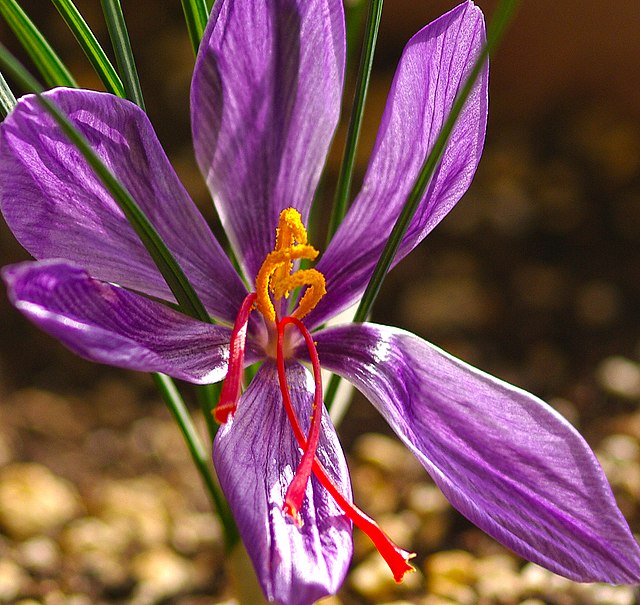
Crocus sativus Wikimedia commons
Saffron is warm and dry in the first degree. There are two types of saffron: “hortensis”, named after the garden in which it is raised, and “orientalis”, since it is grown in the east.
This crocus is put in non-emetic medicines when it produces flowers – in the middle of the flower it produces 3 or 4 small flowers.[12] Entirely red ones should be chosen. Ones with some yellow, however,/
[1] Conglutinative = the quality of knitting together a wound or broken bones. Norri 241.
[2] Thapsia garganica, a toxic relative of the carrot which is still relevant in pharmaceutica reasearch.
[3] Considered a form of dropsy; see Norri 1127.
[4] Quercula (sapling, small oak) is here rendered ground oak. Today, Teucrium chamaedrys is wall germander, the lesser variety, although Platearius identifies “camedreos” with the larger form.
[5] Presumably Platearius means that greater and lesser germander can be prescribed in the same way.
[6] The more costly electuary for urinary stones.
[7] Norri, 331: Electuary said to have been prepared by Abbas Curiae (chaplain of the royal household) for Roger, Duke of Apulia (1085-1111), containing c. 50 herbs, spices, gums, barley sugar, and honey.
[8] Making a distinction between salted freshwater and seawater?
[9] Scaliness, severe dandruff.
[10] Camepitheos. This plant is variously identified: the Alphita (28) calls it “quercula maior.” Hunt (63) suggests three alternatives: ground pine, yellow-rattle, red-rattle. In The Alphabet of Galen, Everett (253) calls the three varieties of it Mountain Germander (Ajuga chia), Herb Ivy (Ajuga iva), and Ground Pine (Ajuga chamaepitys). Mats Rydén, in “The English Plant Names in the Great Herball (1526)” (Stockholm, 1984), 41-42, concludes that it is “mead-rattle,” also known as yellow rattle, scientifically Rhinanthus minor.
[11] Norri, 922: Watery bodily humor thought to drain from brain, dominated by the cold quality.
[12] These are the stamens.
